
Around Europe a particular question is becoming increasingly pressing: How do we shape a just transition that makes real sense for local communities, so that it becomes a rooted and shared endeavour, rather than encountering resistance and leading to polarization? Recent events and elections in Denmark have shown that this is a highly relevant issue for the country despite the reputation as a frontrunner in renewable energy and with high public support for climate action.
The rapid expansion of renewable energy infrastructure has become a central pillar of climate and energy policy in Denmark and in Europe. It is driven by initiatives such as the REPowerEU Plan and the EU Solar Energy Strategy. These frameworks are essential ending the extraction and burning of coal, oil and gas, reducing greenhouse gas emissions and thereby preventing the acceleration of climate change and strengthening Europe’s energy security.
Solar power has been the fastest growing renewable energy source in Europe. June 2025 was the first month in history where solar energy was the main source of electricity generated in the EU, accounting for 22 per cent of the energy mix.
The policies have largely prioritised speed and scale, but along the way an important aspect seems to have been forgotten: the people living right there in the rural areas in the middle of it all.
Social conflicts around Europe
Overall, in Denmark there is broad agreement on the need for a sustainable transition, both socially and politically, with most political parties across the spectrum supporting new sustainable transition reforms, albeit with different views on how and how fast to achieve them. This is often not the case in the rest of Europe.
Yet frustrations over renewable energy projects are leading to social conflicts in form of opposition and protests in Denmark as well as in Germany, Belgium, England, Portugal, Spain, Italy.
The reasons for opposing in Denmark and other countries are similar. Citizens are feeling unheard or negatively affected by the construction of these new parks. The primary themes are destruction of landscape, loss of biodiversity, land grabbing and extractive ownership models, where profits are channelled away from local areas without delivering benefits in return. These dynamics fuel perceptions of loss of control, democratic exclusion and unequal burden-sharing, particularly between bigger cities driving energy demand and rural or economically weaker municipalities hosting energy infrastructure.
Citizens show their opposition by organising in groups, both physically and online. Denmark has as in other countries in recent years seen local opposition to certain large-scale energy park projects gaining much media attention. The citizens organise meetings, make banners, write opinion pieces, use their vote during election and even run for office themselves. Mass mobilisations on the street and sabotage as seen for example in Sardinia, Italy, is not seen in Denmark, though.
The far right and solar energy
Alongside the social conflicts in some rural areas a political twist is added to the development. The frustrations over solar parcs become the subject for political attention. During elections, especially the Danish municipal elections in November 2025, solar parcs became a highly contentious issue in the media, local communities and among politicians. A party on the far right The Denmark Democrats, established in 2022, campaigns explicitly against solar parks under the slogan ‘No to iron fields’, which contributed to their success during the local elections. This was also the case in national election in March 2026. What was also seen during local elections was the rise of several small local lists that competed in local elections opposing the creation of new solar parks, but that did not want to be associated with The Denmark Democrats.
Following the elections, several municipalities has paused or halted renewable energy projects, citing citizen opposition. This illustrates how important the citizens aspect is in the planning of energy parks and how the lack of it can generate political backlash even in countries with high public support for climate action as in Denmark.
When positioning themselves against solar parks The Denmark Democrats are aligning themselves on this issue with some of other parties on the far right in Europe, as for instance Alternative for Germany (AfD). Far-right parties are increasingly mobilizing against climate action in Europe. Though they have taken a green turn in recent years from denying to acknowledging anthropogenic climate change, they are often working against different climate initiatives such as international treaties, CO2 taxes or renewable energy policies and projects.
In countries such as Germany, the Netherlands, France and Denmark parties on the far right are using local frustrations over solar parks and other climate measures to position themselves. But not all parties on the far-right have taken the same stand. According to a study published in the journal ‘Environmental Politics’ several parties are more unclear about the subject and some of them support solar power to some degree to achieve energy self-sufficiency. The parties’ variation in opposition and support indicates that positions towards solar power are driven rather by strategic reasons than by a common ideological stance.
The way forward
All the while an important but more obscure and not as loud countertrend is happening. Across Denmark and Europe, citizens are developing alternative, community-led energy and other forms of transition initiatives, experimenting with new models of ownership, access and co-creation. Citizens come together around energy communities, solar parks, wind turbines, small-scale agriculture and food production, nature restoring, and other ways of kick-starting the transition in their local communities. They do this for the climate, environment, clean water, their community, self-sufficiency, ownership, and to be part of the solution.
These initiatives demonstrate that transition projects can be developed in ways that strengthen local democracy, social cohesion and public support for climate action. However, such solutions remain largely invisible in public debate, policymaking and implementation, and the people engaged in the local projects face many obstacles along the way.
The trans4demo project is looking into both opposition to climate action but is also seeking to understand the forms and potential of community-driven and collectively transformation initiatives and the role of the citizens in the green transition. Hopefully it can bring new knowledge, inspiration and recommendations to build on when moving forward with a rooted transition of our society.
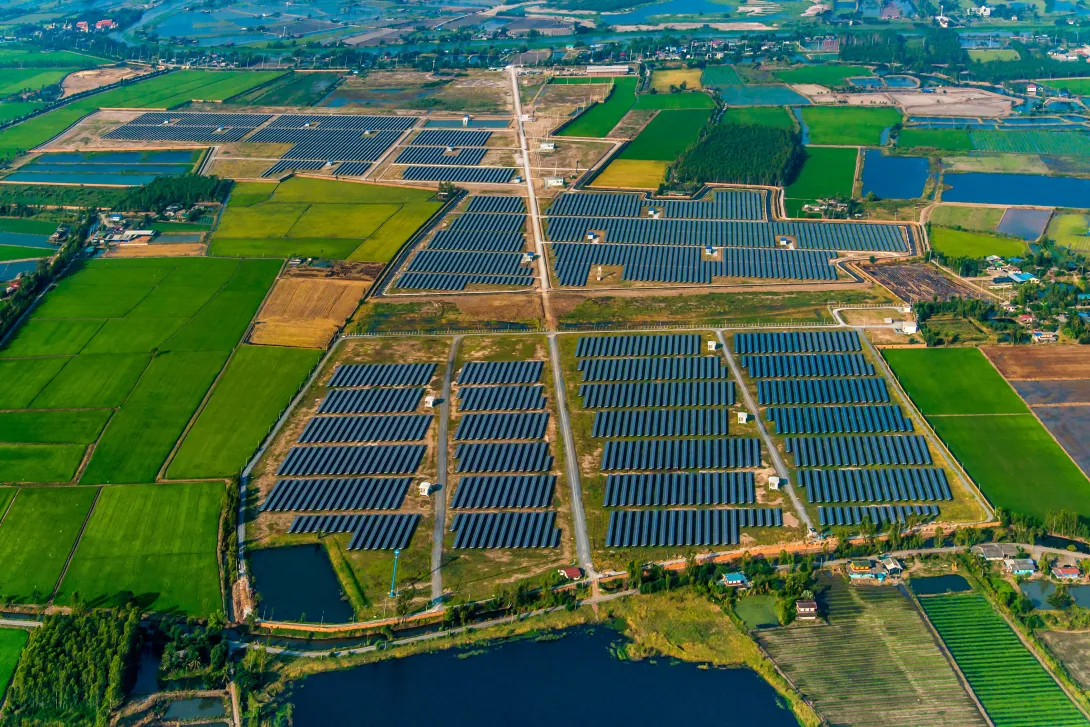
Photo: Solar farm, solar panels photo from the air by praethip