
How to live together with wolves? This question has sparked discussions in the Netherlands before a wolf actually crossed the Dutch border. Now wolves have actually returned with the first settled wolves in 2018, debates surrounding the rewilding are still present, revealing (societal) preoccupations with not only tangible challenges surrounding wolf management and trust in government decisions regarding wolf policy, but also questions regarding (experienced) change for which ‘the wolf’ can function as a symbol (de Groot, 2025; NOS, n.d.; Rijksoverheid, n.d.).
Wolves in Europe: downgrading their legal protection status
Similar discussions about when wolf culling is permitted and what best practices are regarding safeguarding livestock have been debated in political, public, and media contexts in other states in Europe as well. For instance for the German wolf conflict, it has been argued that this can be linked to populism in the type of discourse (Zscheischler & Friedrich, 2022) and how wolves are used as an issue by far-right populist parties (Leser, 2025). For the Netherlands, topics raised include polarised and emotional underpinnings to the debate, and cultural stakes surrounding wolves (de Jonge, 2025).
Related to ongoing debates and even conflicts, which also reached the European level, there has been a push for a balance of interests between biodiversity and (rural) livelihoods. This has been discussed in the context of wolf populations having increased significantly. In the end, in alignment with the updated Bern Convention, changes in the EU Habitats Directive have been approved that alter the level of legal protection of wolves (Council of the EU, 2025). Wolves are now classified as ‘protected’ instead of ‘strictly protected,’ opening up possibilities regarding faster management in case of exceptional circumstances, even though the lowering of protective status also needs to be actively implemented in national legislation and policy of EU states. The decision to classify wolves in a lower protection level has been facing criticism, emphasising how wolf recovery and ecosystem restoration are fragile; for some, the changes have been mainly based on political motivations rather than evidence (WWF, 2025).
Dutch debates surrounding wolves
In the Netherlands, contemporary, contentious politics have also involved local calls for more flexible permit procedures for hunting wolves and, more generally, a safeguarding of Dutch citizens and rural livelihoods (Verburg, 2025). These calls have been, for one, fuelled by increased wolf-human interactions, with the bold wolf behaviour of specifically two wolves, who gained the status of ‘problem wolf’ (Geelen, 2025). Nevertheless, demonstrations in favour of wolf protection also occurred (Extinction Rebellion, 2025; Pennekamp & Woertink, 2025). In short, recent and current wolf management practices in the Netherlands are facing resistance and more generally disagreement for not doing enough in either way: for safeguarding animal rights, nor for Dutch citizens and their livelihoods.
Rewilding, contentious politics, and sustainability transitions
The case of rewilding of wolves in the Netherlands remains a case of interest within the Trans4Demo project, enabling inquiry into the ways in which sociotechnical and socio-ecological transitions involve struggles. The content and the forms that these take can further our understanding of how both politics (actors, trust in government, form of politics) and the course of transitions – including which perspectives and hence actions win out – are interlinked and impacted by these struggles.
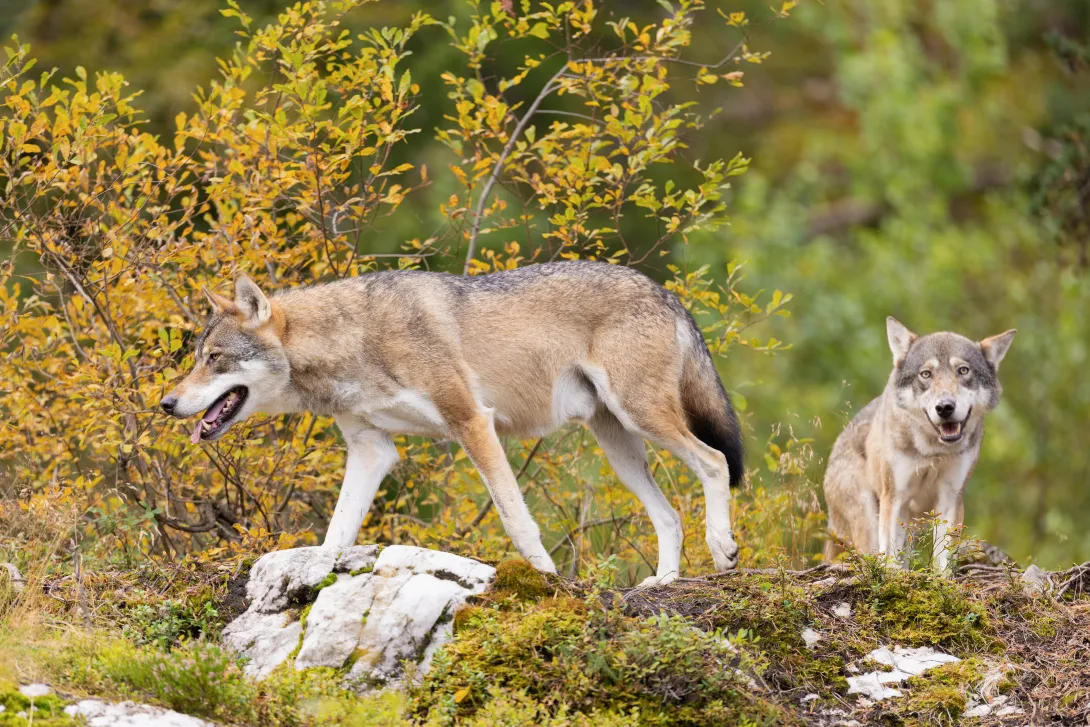
Photo: Two wolves in autumn Scandinavian forest with mossy rocks and golden foliage by kjekol